Vaia Tsiokou
Architect, computational designer*, apiarist, and researcher
"We are all pollinators in our own way. Sharing perspectives, knowledge, and care, we design bridges across borders and our path to flourishing."
Version française en bas de page
〰️
Version française en bas de page 〰️
English version :
Her Background :
Architect, computational designer, apiarist and researcher of Greek-Italian origin, Vaia Tsiokou built her career early on at the intersection of multiple disciplines. Originally trained in Interior Architecture, Applied Arts, and Product Design at the Technological Educational Institute of Athens, she quickly developed an eye for navigating design across scales, from spatial environments down to micro-details.
A major turning point came during an internship at the Eugenides Foundation, where she immersed herself in 3D-printing, robotics, and the maker movement. This sparked her decision to pursue a Master of Science in Integrative Technologies and Architectural Design Research at the University of Stuttgart. Parallel to this, she expanded her understanding of biological systems through postgraduate studies in Biomimetics at the Hellenic Open University.
Vaia’s professional path is currently expanding towards the Joint Research Centre (JRC) of the European Commission, building on her extensive professional experience as a computational designer and project manager in the private sector, where she led EU-funded research and innovation initiatives. Alongside her professional practice, she recently graduated with a Master of Arts by Research in Hybrid Arts from the Ionian University. Her trajectory reflects a practice sitting squarely at the crossroads of science, design, and art.
Vaia’s focus has gradually turned towards inclusivity and more-than-human design for underrepresented groups, driven by ecofeminist ideas and fuelled by embodied design experiences of female forms of collectivity, explored through pole dancing and beekeeping.
Her Practice
Vaia’s practice operates at the intersection of science and art, merging ecological and social responsibility with a rigorous mathematical and technological framework. Rather than restricting herself to traditional drafting, her methodology leverages computational design, additive manufacturing technologies, and custom material formulations to build customisable, architected artifacts.
Her approach spans multiple scales: from the macro down to the micro scale, where she manipulates material formulations directly. Through computational design, the traditional role of the designer undergoes a fundamental shift:
“Computational design is a non-deterministic way of designing. By that, I mean that you don't create a defined design with a known outcome from the start. It is a synergy between intention and emergence.”
For Vaia, design is about “manifesting the reality you want to see.” She has developed a highly sensitive approach to computational design, which she combines with her perspective as a biomimetic designer. She treats materials as programmable entities, bridging the gap between algorithmic control and natural/biological realities, and sees her practice as a genuine form of cooperation with the natural environment. More recently, her interest has expanded towards symbiosis between humans and non-humans, exploring how design can foster interspecies coexistence.
“It is a holistic approach to design that takes into account both environmental and social considerations.”
* Computational designer: A designer who uses code and algorithms to generate forms. Rather than designing a fixed object, they define a set of computational rules that generates and adapts the design based on different parameters, such as material, environmental conditions, and intended use.
Projects
Design of Natural Composites Based on Flax Fibre and Crystallisation
Co-developed with her peers during her time at the University of Stuttgart, the livMatS Pavilion (ITECH / ICD / ITKE / IntCDC, University of Stuttgart and livMatS, University of Freiburg), stands as a pioneering architectural achievement: the world’s first building with a load-bearing structure made entirely from robotically wound natural flax fibre. Its bio-inspired intricate geometry allocates material strictly where required based on structural and stress analysis, establishing a benchmark for resource-efficient, sustainable architecture.
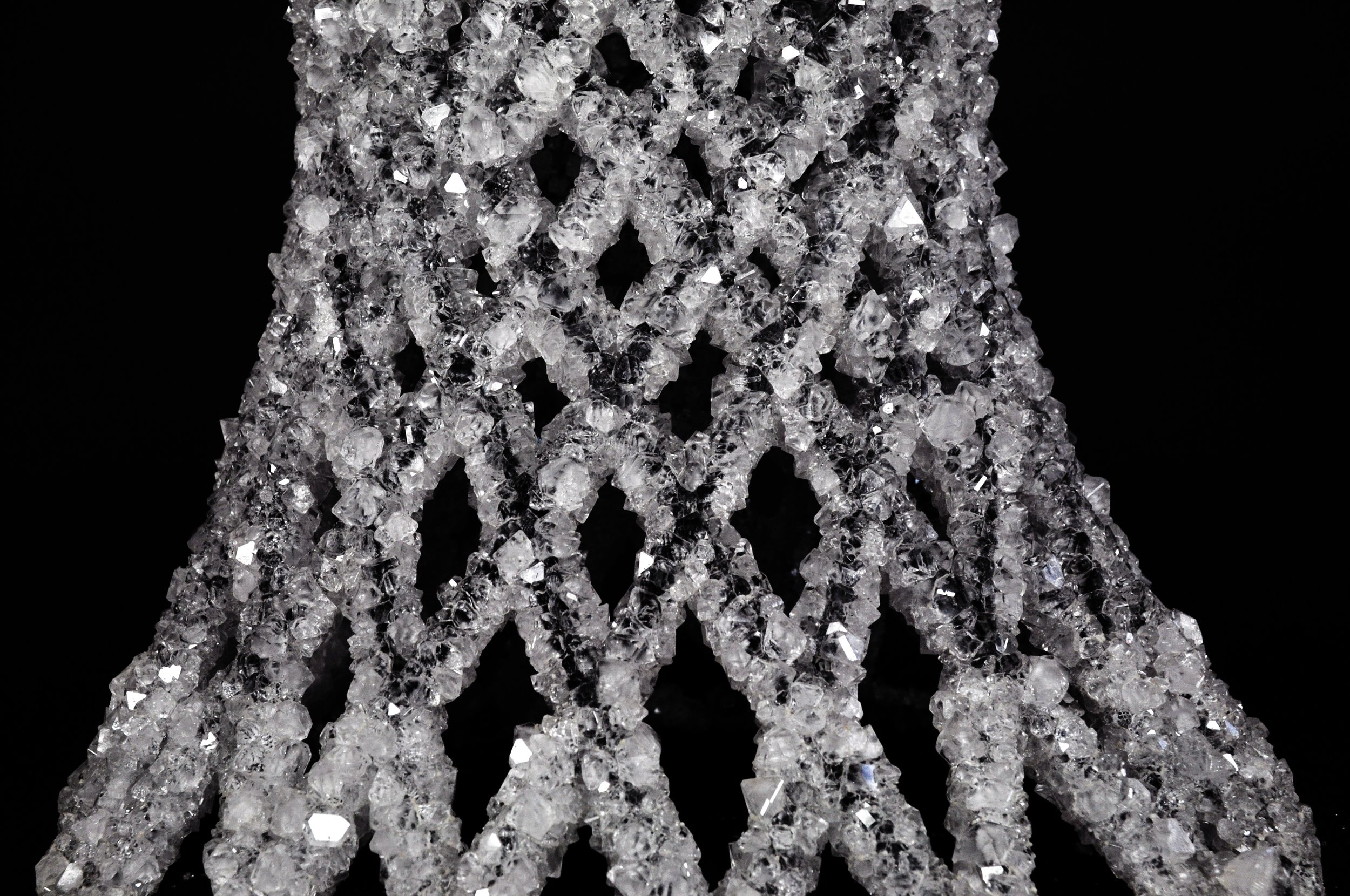
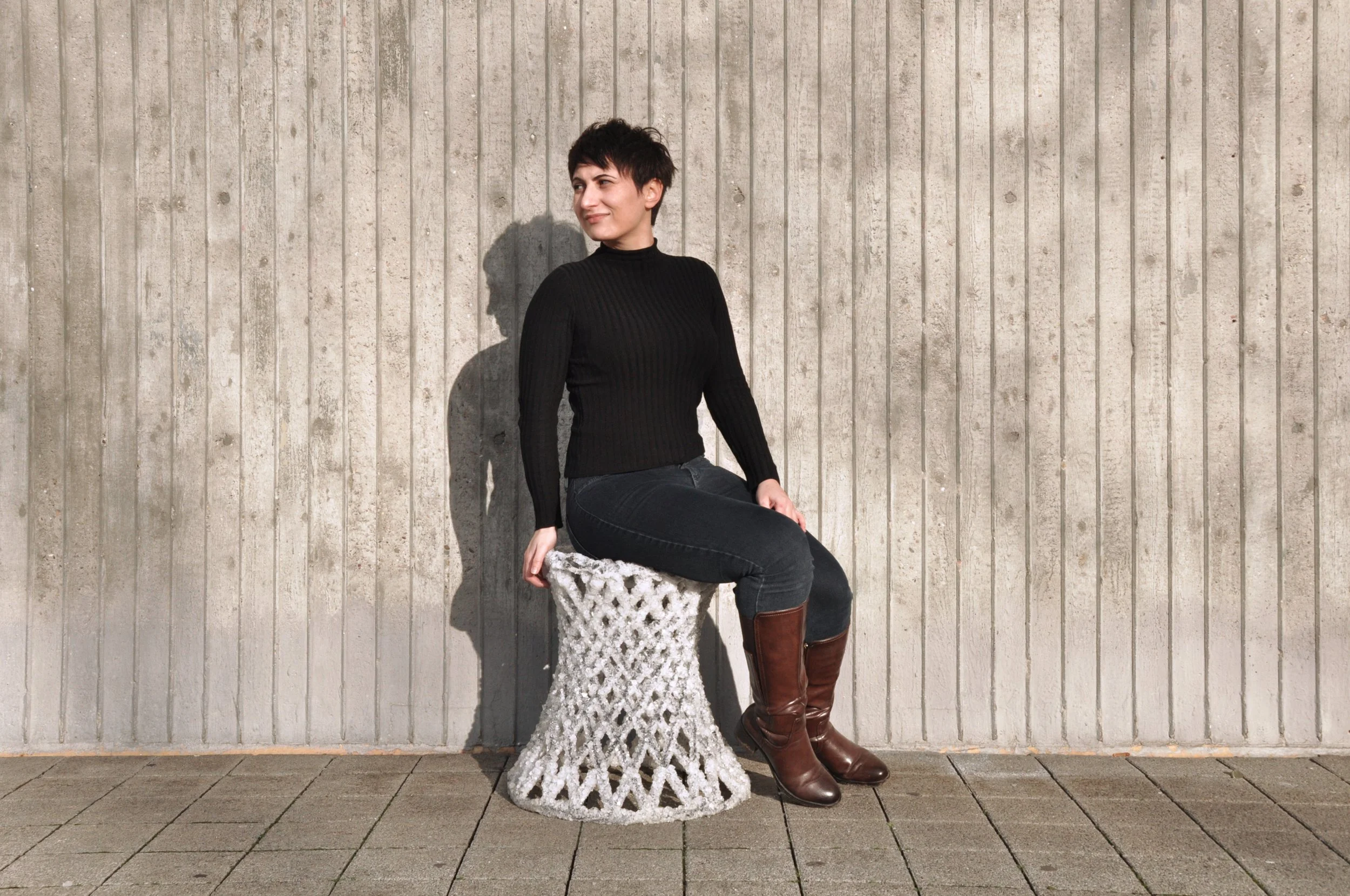
During the same period, building on her experience of material-conscious design, and prompted by concerns over the environmental footprint of synthetic resins in composite manufacturing, Vaia co-developed Crystallized as a master’s student in the research group of Biobased Materials and Materials Cycles in Architecture (BioMat) at the University of Stuttgart. The research explores alternative matrix formulations by crystallising natural salts around cotton thread reinforcements. The resulting prototype, a small-scale stool capable of supporting a load of approximately 80 kg, demonstrates how micro-scale material innovations can inform future macro-scale architectural applications.
3D-Printed Inclusive Toys from Recycled Plastic
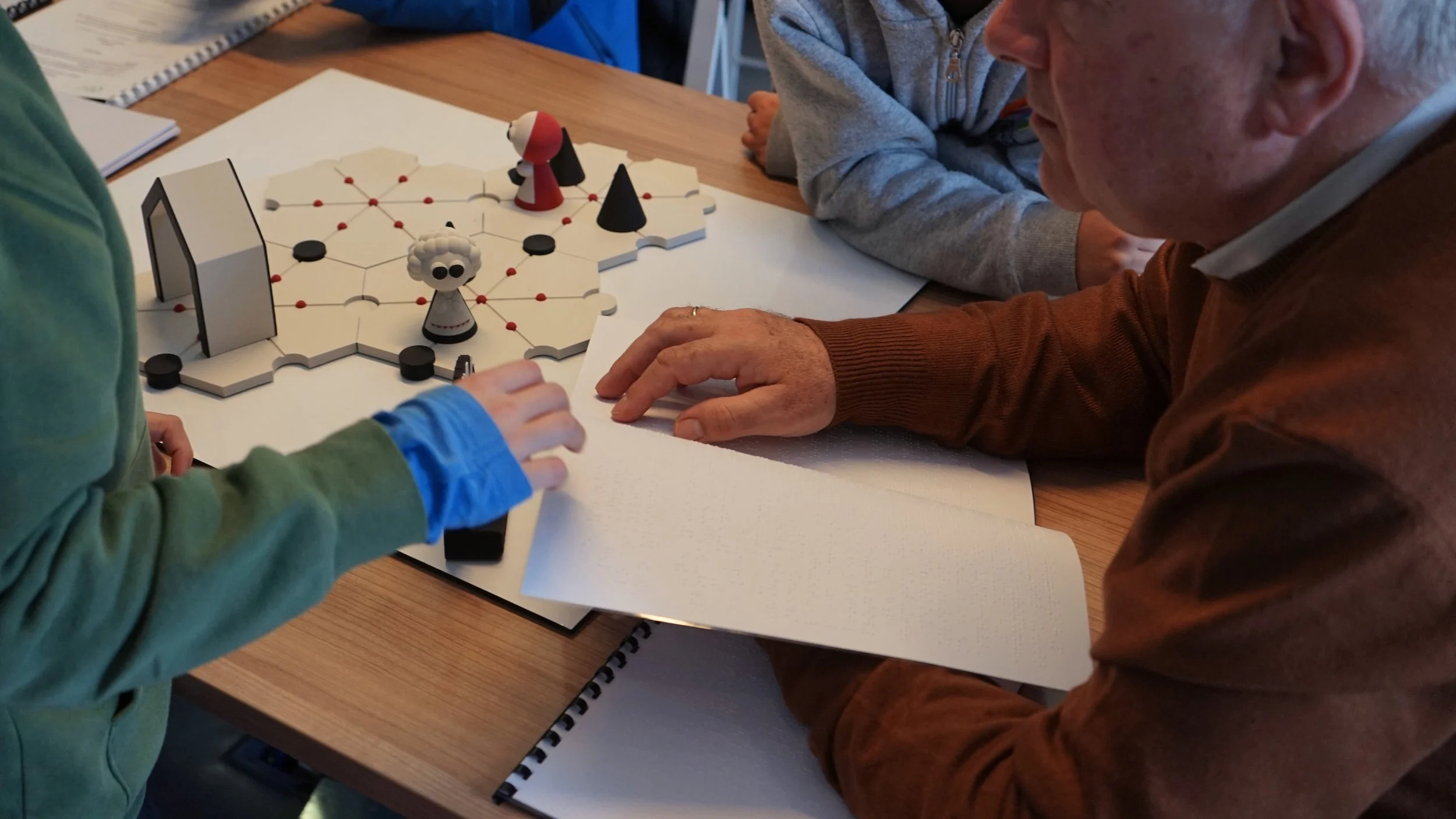
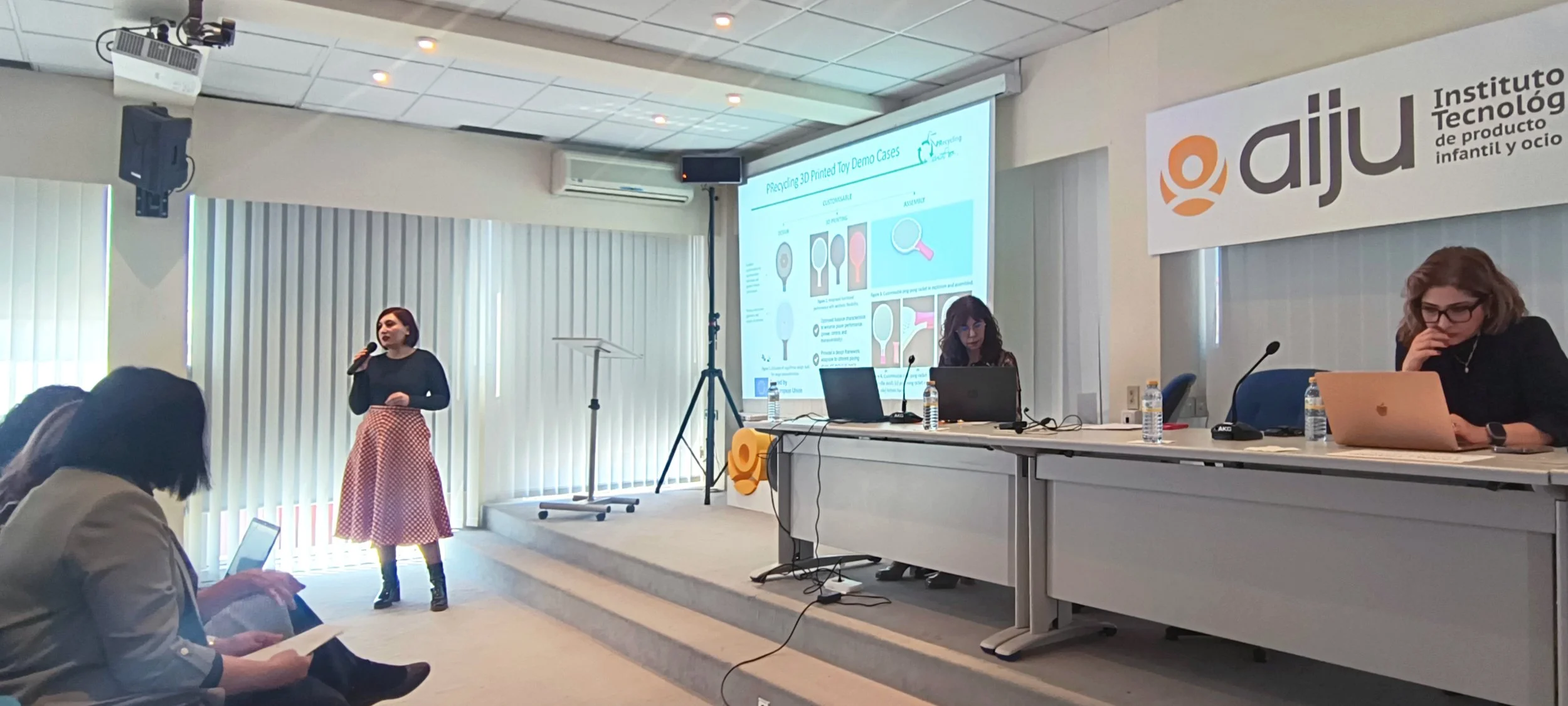
In recent years, Vaia has worked on developing 3D-printed inclusive toys made from 100% recycled plastic at BioG3D in Athens, as part of the EU-funded PRecycling project. With a particular focus on an inclusive fairytale board for both sighted and visually impaired users, as well as gender-inclusive physical activity equipment, her challenge was to leverage computational design methodologies to address diverse user needs through a Design-for-All approach, while also ensuring that the designs met relevant safety requirements and complied with applicable standards and regulations.
In the first design, her research focused on identifying precise geometric and tactile features in relation to material properties, such as colour intensity and contrast, in order to make the toys equally legible and accessible to both sighted and visually impaired users.
In the second, she developed a parametric approach to control the weight and the centre of gravity of the physical activity equipment according to the needs and abilities of diverse users.
The LivArch Project: Interspecies Architecture
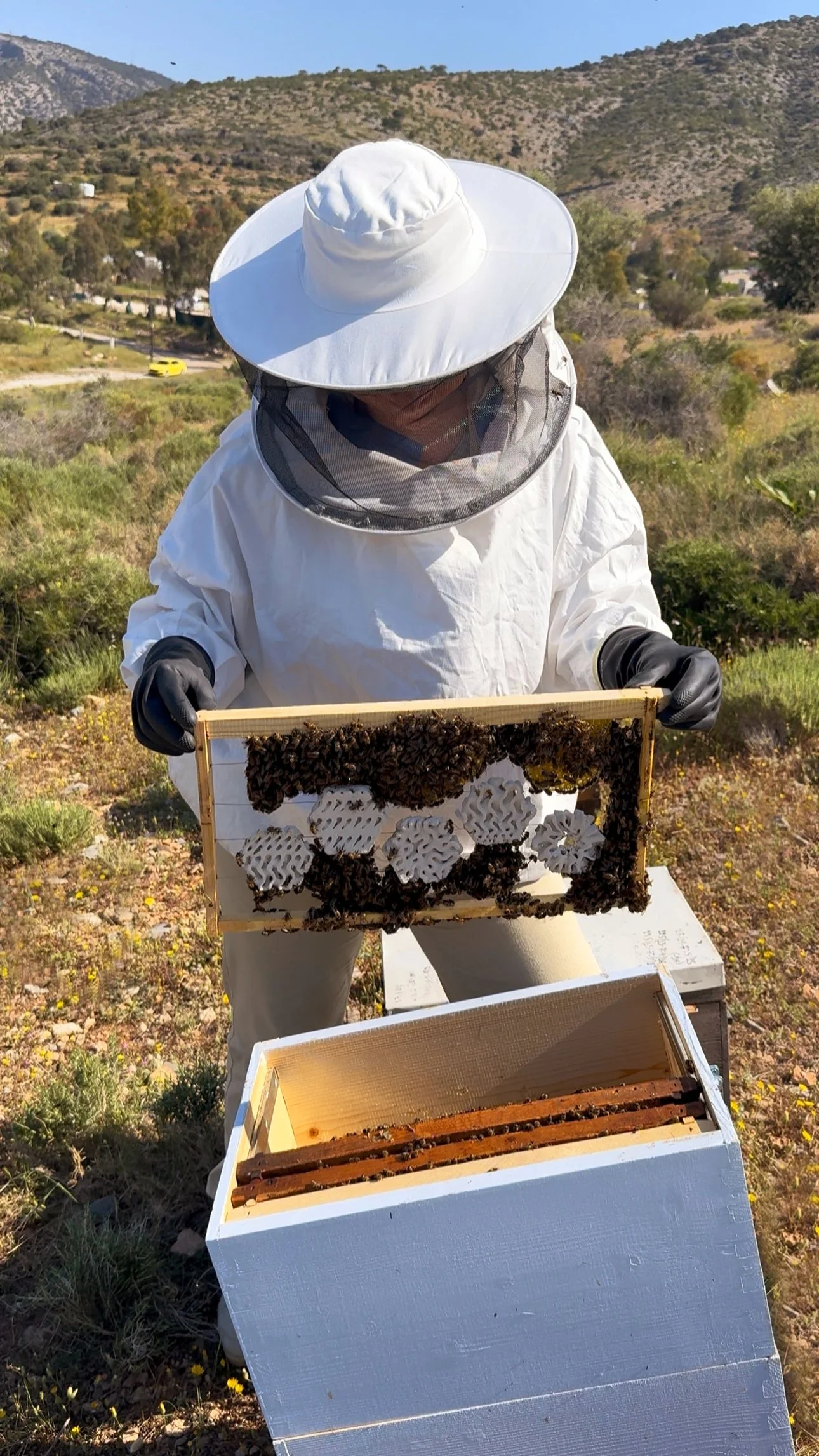
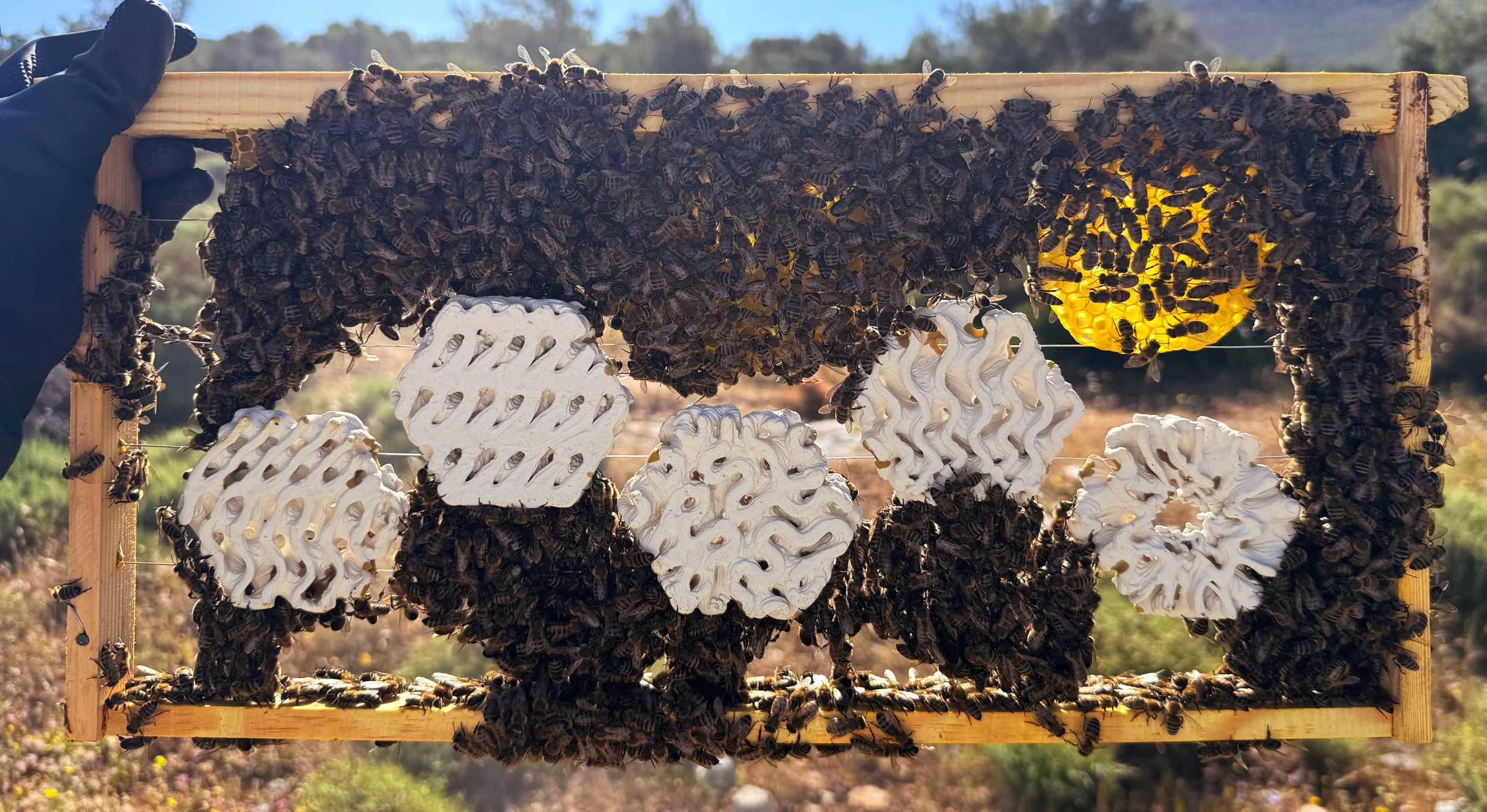
As part of her master’s thesis at the Ionian University, her most recent project, LivArch, challenges traditional human-centred design, by exploring forms of interspecies dialogue, eco-care, and co-creation with bees. In LivArch, Vaia explores how material-conscious digital fabrication can serve both human and more-than-human species, proposing a holistic tectonics approach aimed at preserving and promoting biodiversity in urban settings. Focusing particularly on honeybee pollinators, the project combines material science, computational design and 3D-printing to create habitats with integrated, eco-safe functional properties. In this paradigm, the designer acts partly as an ethologist, setting the initial design intent, listening to the needs of living organisms, and allowing nature to emerge.
Conclusion
Vaia has a unique background that brings together her diverse passions: science, art, and nature. Through her multifaceted experiences, she has combined a rational and mathematical approach, shaped by laboratory research and computational design, with a deep interest in biology, an artistic, conversational understanding of the material and living world, and a strong commitment to environmental issues.
“We are all pollinators in our own way. Sharing perspectives, knowledge, and care, we design bridges across borders and our path to flourishing.”
As a committed designer, she demonstrates how deeply held values can be translated into a meaningful professional practice.
We invite you to follow her ongoing work to discover how design can help improve the way we coexist with the living world.
French version
Son parcours
Architecte, computational designer*, apicultrice et chercheuse d’origine gréco-italienne, le parcours de Vaia Tsiokou s’est construit très tôt à la croisée de plusieurs disciplines. Formée d’abord en Architecture d’Intérieur, Arts Appliqués et Design Produit à l’Institut d’Enseignement Technologique d’Athènes, elle développe rapidement une sensibilité lui permettant d’aborder le design à différentes échelles, du macro jusqu’aux micro. Un tournant majeur de son parcours intervient lors d’un stage à la Fondation Eugenides, où elle s’immerge dans l’impression 3D, la robotique et le mouvement maker. Cette expérience l’amène à intégrer le Master of Science en Integrative Technologies and Architectural Design Research à l’Université de Stuttgart. En parallèle, elle approfondit son intérêt pour le vivant et la science à travers une formation post-universitaire en biomimétique à l’Université Ouverte Hellénique.
Aujourd’hui, la poursuite du parcours de Vaia s’oriente vers le Centre commun de recherche (JRC) de la Commission européenne. Parallèlement à sa pratique professionnelle, elle a récemment obtenu un Master of Arts by Research en Hybrid Arts à l’Université Ionienne.
Un parcours hybride, qui reflète une pratique située entre science, design, et art.
Le travail de Vaia s’est progressivement orienté vers l’inclusivité et le design «more-than-human» pour les groupes sous-représentés, guidé par des idées écoféministes et nourri par des expériences incarnées de formes féminines de collectivité, explorées à travers la pole dance et l’apiculture.
Sa pratique du design
La pratique du design de Vaia est à la frontière entre la science et l'art, mêlant ses convictions écologiques et sociales à une approche rationnelle, mathématique et technologique. Plutôt que de se limiter au dessin traditionnel, sa méthodologie s’appuie sur le design computationnel, les technologies de fabrication additive et la formulation de matériaux sur mesure afin de créer des artefacts architecturés et personnalisables.
Sa démarche se déploie à différentes échelles, de l’échelle macro jusqu’à l’échelle micro, où elle intervient directement sur la formulation des matériaux. À travers le design computationnel, le rôle traditionnel du designer est modifié :
«Le design computationnel est une manière non déterministe de designer. J’entends par cela que l’on ne crée pas un design précis dont on connaîtrait le résultat dès le départ. C’est une synergie entre l'intention et l’émergence.»
Pour Vaia, designer consiste à «manifester la réalité que l’on souhaite voir advenir». Elle a réussi a développé une approche très sensible du design computationnel, qu'elle combine avec sa casquette de designer biomimétique. Elle considère les matériaux comme des entités programmables, créant un pont entre le contrôle algorithmique et les réalités naturelles et biologiques, et envisage sa pratique comme une véritable coopération avec l’environnement naturel.
Plus récemment, son intérêt s’est élargi à la symbiose entre l’humain et le non-humain, explorant comment le design peut favoriser une cohabitation interespèces.
«Il s'agit d'une approche globale du design, qui prend en compte à la fois les aspects environnementaux et les aspects sociaux.»
* Computational designer: Designer qui utilise le code et les algorithmes pour générer des formes. Plutôt que de dessiner un objet figé, il définit un ensemble de règles computationnelles qui génèrent et adaptent le design en fonction de différents paramètres, tels que le matériau, les conditions environnementales et l’usage prévu.
Quelques projets
Conception de Composites Naturels à Base de Fibres de Lin et de Cristallisation
Co-développé avec ses pairs durant ses études à l’Université de Stuttgart, le livMatS Pavilion (ITECH / ICD / ITKE / IntCDC, Université de Stuttgart et livMatS, Université de Fribourg) constitue une réalisation architecturale pionnière: il s’agit du premier bâtiment dont la structure porteuse est entièrement réalisée en fibres naturelles de lin enroulées robotiquement. Sa géométrie complexe, bio-inspirée, répartit la matière uniquement là où elle est nécessaire, sur la base d’analyses structurelles un projet architectural durable et économe en ressources.
Durant la même période, s’appuyant sur son expérience de la conception attentive aux matériaux et motivée par les préoccupations liées à l’empreinte environnementale des résines synthétiques utilisées dans la fabrication des composites, Vaia a co-développé Crystallized dans le cadre de son master, au sein du groupe de recherche Matériaux Biosourcés et Cycles des Matériaux en Architecture (BioMat) de l’Université de Stuttgart. Cette recherche explore des formulations alternatives de matrice par la cristallisation de sels naturels autour de renforts en fils de coton. Le prototype obtenu, un tabouret à petite échelle capable de supporter une charge d’environ 80 kg, démontre comment des innovations matérielles à l’échelle microscopique peuvent nourrir de futures applications architecturales à l’échelle macroscopique.
Jouets Inclusifs Imprimés en 3D à Partir de Plastique Recyclé
Ces dernières années, Vaia a travaillé au développement de jouets inclusifs imprimés en 3D à partir de plastique 100% recyclé chez BioG3D, à Athènes, dans le cadre du projet européen PRecycling. En se concentrant notamment sur un plateau de conte inclusif destiné aussi bien aux personnes voyantes qu’aux personnes malvoyantes, ainsi que sur des équipements d’activité physique inclusifs en matière de genre, son défi consistait à mobiliser des méthodologies de conception computationnelle afin de répondre aux besoins d’une diversité d’utilisateurs selon une approche de conception universelle («Design-for-All»), tout en veillant à ce que les conceptions soient conformes aux normes et réglementations applicables (très nombreuses dans le secteur de l’enfance).
Pour ces projets, ses recherches se sont concentrées sur la recherche de matériaux et leurs spécificités “tactiles” afin de rendre les jouets aussi lisibles et accessibles aux personnes voyantes qu’aux personnes malvoyantes. Elle a aussi développé un travail pointu de recherche pour contrôler le poids et le centre de gravité des équipements pour les adapter aux besoins et des capacités de différents utilisateurs.
Le Projet LivArch: Architecture Interespèces
Dans le cadre de son mémoire de master à l’Université Ionienne, son projet le plus récent, LivArch, remet en question les approches traditionnelles de la conception centrées sur l’humain en explorant de nouvelles formes de dialogue interespèces, de soin écologique et de co-création avec les abeilles. À travers LivArch, Vaia étudie comment la fabrication numérique, fondée sur une utilisation consciente et responsable des matériaux, peut répondre aux besoins des espèces humaines comme non humaines.
Elle propose ainsi une approche visant à préserver et à favoriser la biodiversité en milieu urbain. En se concentrant notamment sur les abeilles mellifères en tant que pollinisatrices. Le projet associe science des matériaux, conception computationnelle et impression 3D afin de créer des habitats intégrant des propriétés fonctionnelles et écologiquement sûres.
Dans ce projet, le designer endosse en partie le rôle d’un éthologue: il définit l’intention initiale du projet, se met à l’écoute des besoins des organismes vivants et laisse à la nature la possibilité d’émerger et de participer au processus de conception.
Conclusion
Vaia a un parcours singulier qui réunit ses différentes passions: la science, l’art, et le vivant. Elle a, par ses différentes expériences, réussi à conjuguer une approche rationnelle et mathématique (à travers le travail en laboratoire et l’approche computationnelle) avec un profond intérêt pour la biologie, une compréhension artistique et fondée sur le dialogue du monde matériel et du vivant, et de fortes convictions écologiques.
«Nous sommes tous, à notre manière, des pollinisateurs. En partageant nos perspectives, nos connaissances et notre attention aux autres et au vivant, nous créons des ponts au-delà des frontières et dessinons notre chemin vers l’épanouissement.»
Designer engagée, elle illustre avec justesse la manière dont des convictions peuvent s’incarner dans une pratique professionnelle porteuse de sens.
Ainsi nous vous invitons à suivre de près ses travaux en cours pour découvrir comment le design peut améliorer notre cohabitation avec le vivant!